Wando Welch Terminal: The Structural Cost of a Truck-Dependent Design
Wando Welch Terminal (WWT) is a high-volume container terminal with a fundamental constraint: it is not rail-served. As a result, containers moving between Wando and the region’s rail yards must be handled by truck across an urban highway network. This page summarizes the documented trucking requirement, the recurring RapidRail expense, and the public infrastructure cost exposure associated with sustaining a Wando-centric operating pattern.
Executive Summary
Wando Welch Terminal is a high-volume facility built without rail access, requiring rail-bound containers to be trucked roughly 12 miles across the region’s highway network to reach the North Charleston rail yards.
Port records show Wando generates the dominant share of systemwide truck gate moves, reflecting a routing pattern that concentrates truck-dependent activity at the terminal least suited for rail. To offset this structural constraint, the Port spends approximately $38.8 million annually on the RapidRail trucking subsidy—about $115 per container move.While RapidRail is used across the system—including limited volumes associated with the North Charleston Terminal—the Port has not publicly disclosed a terminal-level allocation of program costs or volumes.
Meanwhile, capacity at other terminals is not utilized at comparable scale, increasing truck mileage and shifting major highway and bridge costs onto taxpayers. The core issue is system routing: concentrating volume at a truck-dependent terminal drives recurring operating subsidies and infrastructure demands that could be reduced through different utilization choices.
Key claim: This is not a “truck traffic problem.” It is a terminal routing problem that produces predictable subsidies and predictable highway expansion pressure.
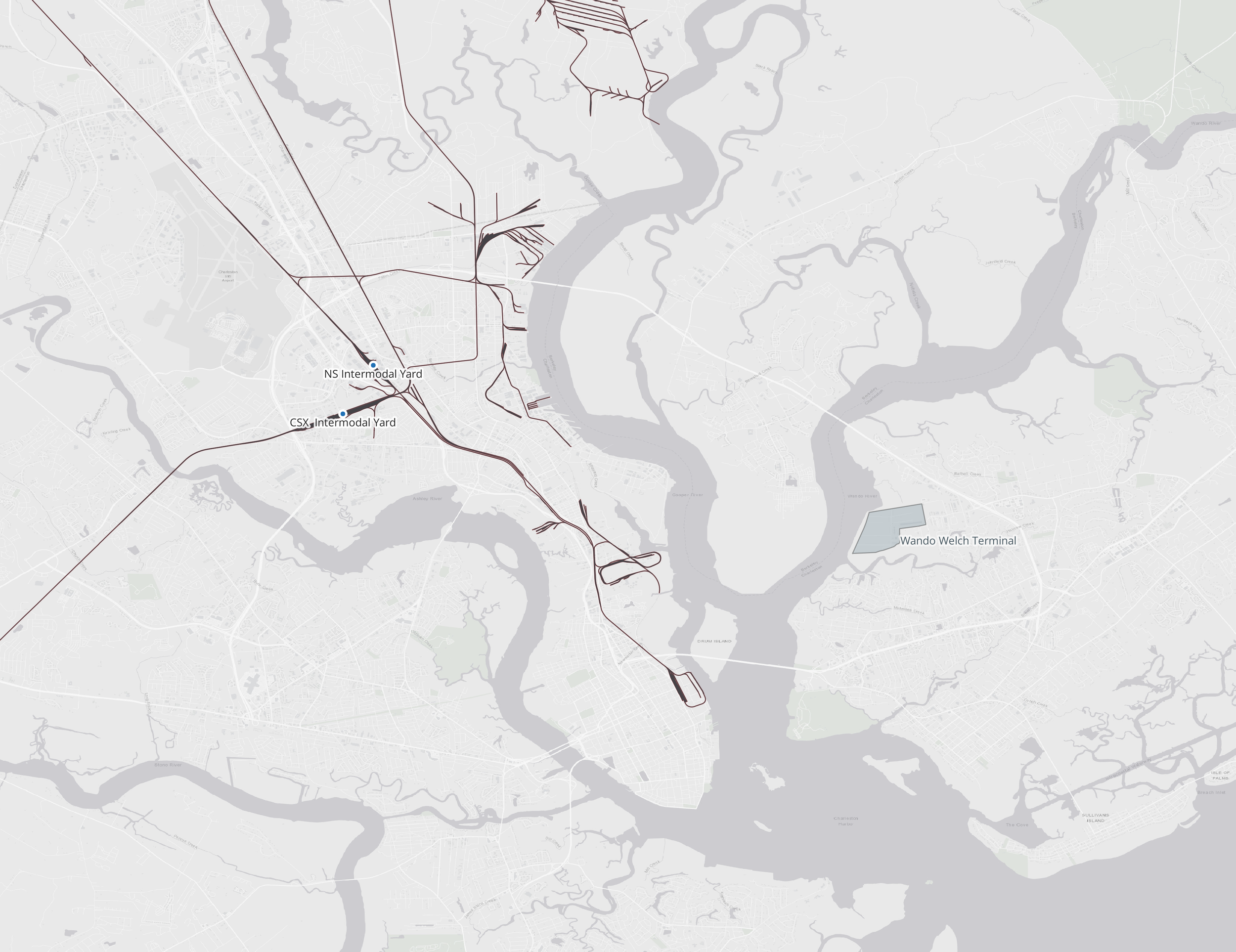
Charleston Rail Infrastructure Map - This map shows the freight rail lines serving the Charleston region. Wando Welch Terminal is not located on a mainline rail yard, so containers must move by truck to reach CSX or Norfolk Southern intermodal facilities via Long Point Road and I-526, crossing both the Wando River and the Cooper River (Don Holt Bridge).
What Wando Is — and What It Is Not
Wando is not rail-served. Rail-bound containers handled at Wando require a truck move between the terminal and the rail yards in North Charleston. This is a structural design constraint — not a short-term operational issue.
1) The Core Fact (Documented): Rail Containers Require a ~12-Mile Truck Trip
The Ports Authority and related project materials describe a consistent reality: rail containers associated with Wando require a truck trip of roughly 12 miles across the local highway network to reach the rail yards in North Charleston. This distance matters because it converts rail moves into a recurring truck-mile requirement.
“Currently, import and export containers being transported via rail to or from the Wando Welch Container Terminal (WWT) must make a 12-mile truck trip to the current rail yards in North Charleston, via I-26 to I-526 for NS and Rivers Avenue to I-526 for CSX.”1

Visual reference: the trucking corridor experienced daily by drivers moving containers between Wando and the North Charleston rail yards.
2) Where the Trucks Actually Are: Gate Moves by Terminal
The most direct way to measure port-generated truck traffic is gate moves — each truck entry or exit through a terminal gate. During the three-month period shown below, the Port recorded 453,193 container truck gate moves in total: Wando Welch Terminal accounted for approximately 86%, compared to about 9% for North Charleston and 5% for Leatherman.

Exhibit: Total container truck gate moves by terminal (May–July 2025). Wando accounts for the dominant share of system-wide container truck activity.
This concentration reflects how container operations are currently routed across the system — and explains why port-related truck impacts are disproportionately experienced along the Wando–I-526 corridor.
3) RapidRail: A Recurring Operating Subsidy (~$38.8M in FY 2025)
A truck-based rail shuttle is expensive. In FY 2025 materials, the RapidRail program is shown at approximately $38.8 million.
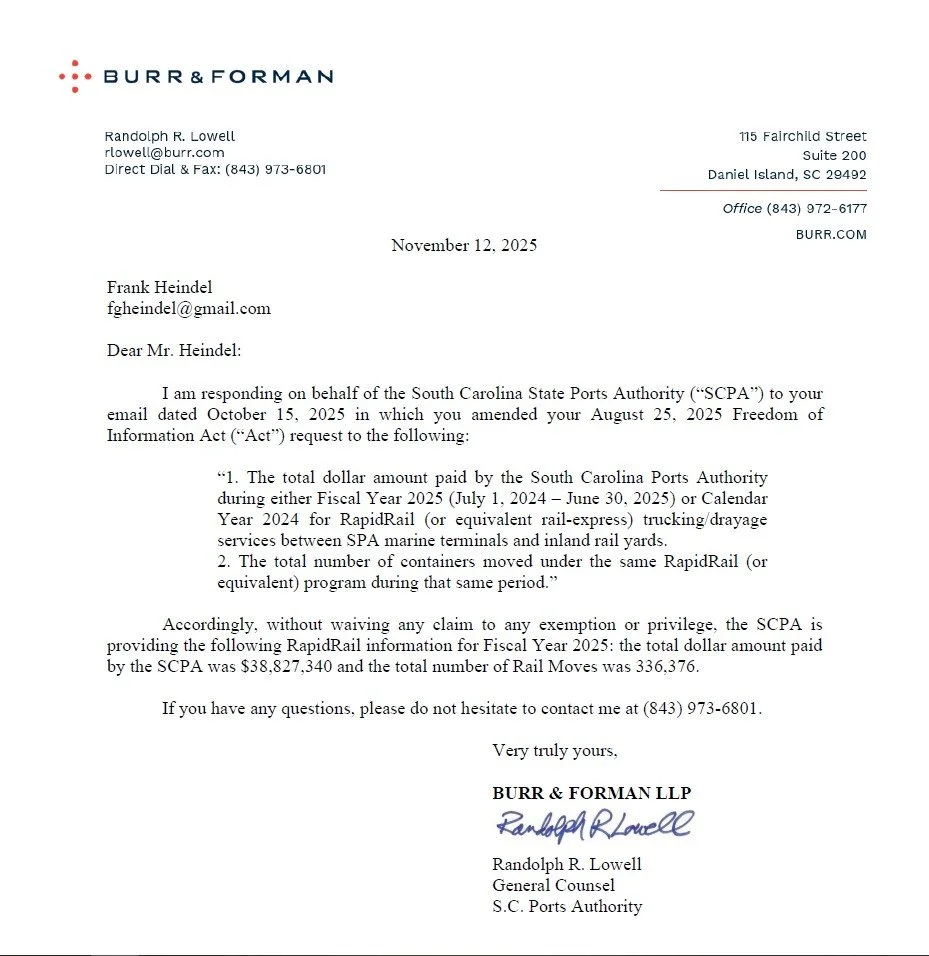
Correspondence confirming approximately $38.8 million in RapidRail expenditures and 336,376 subsidized container moves (FY 2025).
Using the Ports Authority’s reporting of 40-foot containers (“boxes”), not TEUs, the implied per-move cost can be summarized as follows:
| RapidRail Expenditures (FY 2025) | $38.8M |
|---|---|
| Subsidized Moves (FY 2025) | 336,376 (40-ft boxes) |
| Implied Cost per Box | ~$115 |
RapidRail is not a truck-reduction program. It is a competitive operating subsidy that pays for short-haul trucking to inland rail yards in order to make Charleston comparable to ports with direct rail access.
Port production data also shows that only a minority of Wando’s container volume is handled via rail drayage in any given month. Even when RapidRail volumes increase, the overwhelming majority of containers remain truck-dependent. (Source: South Carolina Ports Authority monthly production data) [PDF]

Exhibit: RapidRail production (Dec 2024–Feb 2025). This reflects subsidized trucking used to connect containers to inland rail yards.
4) A System-Level Issue: Volume Concentration at a Truck-Dependent Terminal
If most container activity is concentrated at Wando while capacity exists elsewhere in the system, the outcome is higher truck mileage and continued dependence on highway capacity. This is a utilization and routing question — not a question of whether Wando can operate.
SC Ports’ own reporting of Total Pier Containers (physical containers handled at each terminal) quantifies how container volume is currently distributed across the system.
Pier Containers by Terminal (FY 2025)
Pier containers by terminal (FY 2025 year-to-date, period ending June 30, 2025).2
Arithmetic: Wando handled 1,154,652 ÷ 75,931 = 15.2× as many containers as Leatherman in FY 2025.2
The Choice: Every container drayed from Wando to North Charleston is a choice to bypass a rail-capable terminal at Leatherman, significantly increasing the infrastructure burden on Charleston’s highway system.
Note: “Total Pier Containers” reflects physical container units handled. Terminal capacity is often reported in TEUs (size-normalized units).
Source PDF: Total Pier Containers by Terminal (FY 2024 & FY 2025) 2
5) Externalized Infrastructure Costs: Documented Highway and Bridge Needs
Public materials used in port planning explicitly frame major transportation projects as port-related needs. These costs are not the port’s operating expenses. They are taxpayer-funded transportation projects that interact directly with a truck-dependent freight pattern.
| Projects Cited in Public Materials | How They Are Framed |
|---|---|
| $5.0B — Widen I-526 from the I-26/I-526 interchange to the Port (includes Don Holt + Wando bridge scope) | Port-related inland transportation need; widening framed as necessary to accommodate freight growth |
| $1.3B — I-26 / I-526 interchange improvements (Charleston) | Described as required to “set the stage” for widening I-526 to the Port |
| $325M — I-526 / Long Point Road flyover | Designed to reduce operational conflicts between port-related and local traffic |
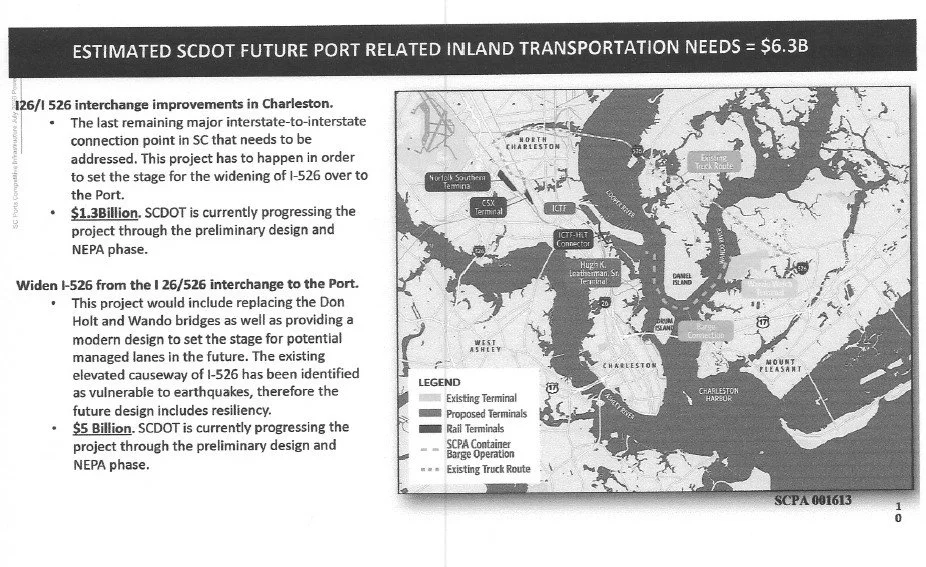
Source image: Port planning slide summarizing “Estimated SCDOT future port related inland transportation needs = $6.3B.”3
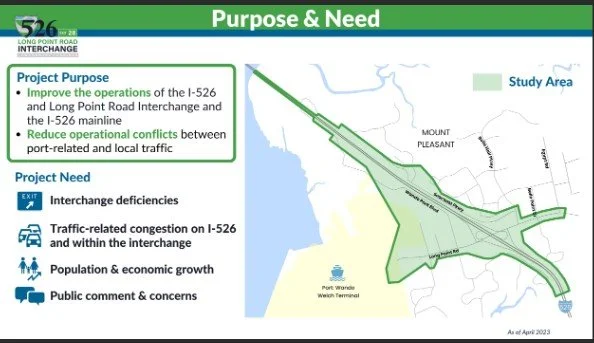
Source image: SCDOT purpose-and-need statement for the I-526 / Long Point Road flyover (port-related congestion).3
Conclusion: A Solvable System Problem
Wando’s lack of rail means the port system pays for trucking to enable rail moves, and the region remains sensitive to highway capacity constraints.
At minimum, the Port should:
- Disclose RapidRail costs and container volumes annually, with terminal-level attribution, in a consistent public format.
- Articulate specific, measurable goals for utilizing the Hugh Leatherman Terminal to offset truck-dependent activity concentrated at Wando.
- Provide a public plan describing how truck-dependent rail shuttling is reduced over time.
References
- Palmetto Railways Intermodal Container Transfer Facility Briefing Memo (rail move requires ~12-mile truck trip).
- South Carolina Ports (provided via SCPA communications), Total Pier Containers by Terminal (FY 2024 & FY 2025).
- Port planning materials showing “Estimated SCDOT future port related inland transportation needs = $6.3B” and related I-526/Don Holt scope (source slide reproduced in the briefing memo).